

During a recent transfer pricing assessment, a client shared an intercompany agreement executed at the company’s inception. The agreement required interest to be paid on the initial funding provided by the parent company. No interest had been charged, and the amount had been outstanding for three to four years.
Nobody involved saw this as a problem. The funding had supported the business since day one, the parties were related, and charging interest between related entities felt like an unnecessary formality. This is a common pattern across UAE groups: interest-free funding between a parent and its subsidiary, or between a shareholder or director and their company, treated as routine rather than as a transaction with tax consequences.
Under UAE Corporate Tax, it is not routine. It is a related-party transaction, and it is subject to the arm’s length principle.
Why “Interest-Free” Isn’t Neutral
In a genuine, unrelated commercial relationship, no lender extends funds without pricing the risk. A bank assesses the borrower’s creditworthiness, the purpose of the loan, the term and the available security before agreeing a rate. A borrower, in turn, weighs the available alternatives before accepting those terms. Both sides negotiate because their interests are not aligned.
Related parties do not face that friction. A parent company and its subsidiary, or a shareholder and their business, can agree to zero per cent simply because there is no independent counterparty pushing back. That absence of negotiation is precisely what Article 34 of the UAE Corporate Tax Law (Federal Decree-Law No. 47 of 2022) is designed to address. It requires related-party transactions, including loans, to reflect the price or rate that unrelated parties would have agreed under comparable conditions. Where a related-party loan carries no interest, the Federal Tax Authority (FTA) can impute a market-rate interest amount and add it to the lender’s taxable income, whether or not that interest was ever actually charged or received.
The starting question for any related-party loan should not be whether the parties agreed to zero per cent. It should be whether an independent lender, assessing this borrower on its own merits, would have made the loan on these terms at all.
What “Arm’s Length” Actually Means for a Loan
An arm’s length rate is not a nominal figure inserted to satisfy a compliance checklist. It is a benchmarked rate, derived from what a genuinely independent lender would charge, based on the borrower’s creditworthiness, the loan’s currency and tenor, the availability of security, and prevailing market conditions for comparable debt.
Establishing that rate requires more than a single reference number. It requires assessing whether the borrower could have secured the funding elsewhere on similar terms, at what cost, and whether the structure of the loan itself makes commercial sense. A subsidiary that is thinly capitalised and would not qualify for third-party debt on any terms raises a different question entirely: whether the “loan” reflects genuine debt, or whether it is functioning as equity that has simply been labelled a loan. Where that is the case, the FTA and the OECD framework that informs UAE transfer pricing practice both allow the transaction to be viewed according to its real economic substance, not its paperwork.
This is the shift businesses need to make: from treating zero per cent as a default position that requires no justification, to treating every related-party financing arrangement as a transaction that must be actively benchmarked and documented.
How the Analysis Changes by Counterparty
The arm’s length question is the same in every case, but the practical assessment shifts depending on who is on the other side of the loan.
Company-to-company loans
Intercompany funding between a parent and subsidiary, or between sister entities, is the clearest case for full benchmarking: a credit assessment of the borrowing entity, a comparison against third-party lending terms for similar businesses, and a rate that reflects that entity’s actual standing, not the group’s consolidated strength.
Shareholder loans
Where a shareholder funds the company, or the company funds the shareholder, the question extends beyond pricing to characterisation. A heavily debt-funded, thinly capitalised company signals that an independent investor would have injected equity rather than extended an unsecured, interest-free loan. That distinction affects not just the interest position but how the funding is treated for tax purposes altogether.
Director loans
These carry a more personal dimension and often involve smaller amounts, but the same principle applies. A loan to a director or senior shareholder still needs a commercial basis and, where material, a benchmarked rate. Treating it as a personal courtesy rather than a transaction is exactly the kind of assumption that draws scrutiny.
In every case, the underlying test is consistent: would an independent party, acting in its own interest, have agreed to this arrangement on these terms?
Documentation: What Actually Defends the Position
A benchmarked rate is only useful if it can be evidenced. Businesses with related-party financing arrangements should be able to demonstrate the commercial rationale for the loan, the creditworthiness assessment carried out (or that should have been carried out) at the time, and how the applied rate compares to market terms for similar debt. Where a business falls within the UAE transfer pricing documentation and disclosure requirements, this evidence also feeds directly into its Local File and the related-party disclosures submitted with the Corporate Tax return.
Documentation prepared after the FTA raises a question is materially weaker than documentation prepared at the time the loan was made. The commercial rationale should exist because the loan actually had one, not because a review has forced it to be written down retroactively.
What Businesses Should Do
For any business with existing related-party financing arrangements, whether formal loans or long-outstanding intercompany balances, the practical response is the same:
- Identify all related-party loans, receivables and payables, including long-outstanding balances that have never been formally reviewed.
- Assess the credit rating and repayment capacity of the borrowing entity or individual.
- Benchmark the arm’s length interest rate that would apply to a comparable, unrelated transaction.
- Compare that rate against what has actually been charged, including zero per cent.
- Adjust where a gap exists, making the appropriate transfer pricing adjustment and documenting the basis for it.
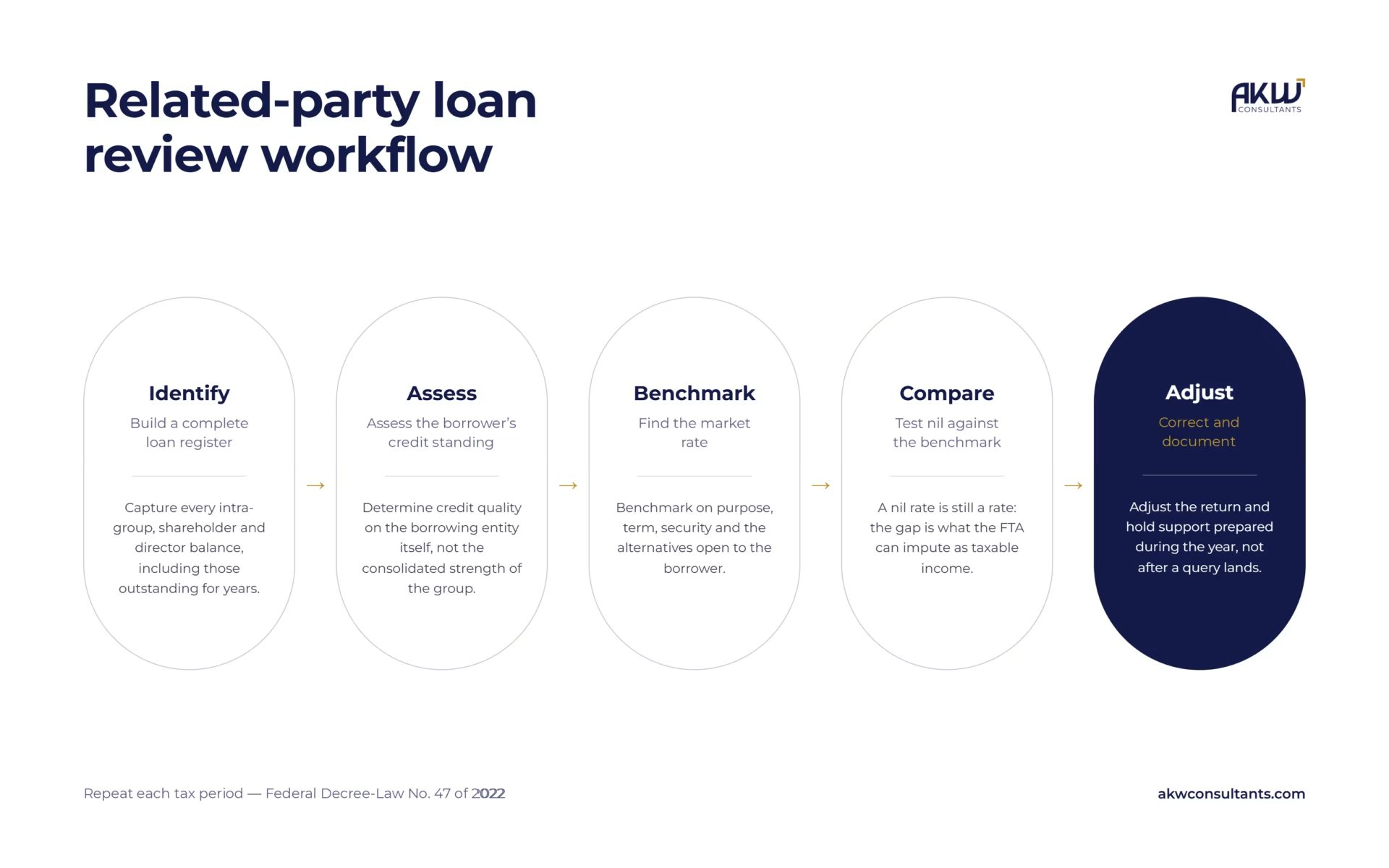
This is not a one-time exercise tied to a tax return deadline. Related-party financing arrangements should be reviewed as part of ongoing governance, not identified retroactively when the Corporate Tax return is being prepared.
The Real Issue Isn’t the Interest Rate
The recurring pattern across these arrangements is not that businesses are deliberately avoiding tax. It is that interest-free related-party financing is treated as an administrative non-event rather than a transaction with genuine commercial substance. Moving from “zero per cent because the parties agreed to it” to a documented, benchmarked position is the difference between a defensible arrangement and one that invites an FTA adjustment.
AKW Consultants advises groups and shareholders across the UAE on structuring, benchmarking and documenting related-party financing arrangements in line with UAE Corporate Tax and transfer pricing requirements.