Introduction
A question we hear regularly from finance teams runs along these lines: our holding company earns dividends, our hospital bills insurers rather than patients, and our new subsidiary has not traded yet, so e-invoicing is surely a matter for later. In each case, the answer now turns on facts that the Ministry of Finance has set out in far more detail than before.
UAE e-invoicing is not limited to large, VAT-registered businesses. It applies to any Person conducting Business in the UAE, regardless of VAT registration status, unless a specific exclusion applies. What has changed in recent weeks is the level of precision on who sits inside that scope, and what it costs to be late.
This article sets out what version 2.0 of the UAE Electronic Invoicing Guidelines clarifies for specific business structures, what the new penalty regime under Cabinet Decision No. 173 of 2026 provides, and the steps finance leaders should take before their implementation date.
What Changed in Late October 2026
Two instruments were issued within four days of each other, and they are best read together.
- UAE Electronic Invoicing Guidelines, Version 2.0 (26 October 2026): published by the Ministry of Finance, the updated Guidelines replace the earlier edition and expand the guidance on scope, identification, storage, advance payments and specific transaction scenarios. The headline go-live date of 1 January 2027 for the first phase is unchanged.
- Cabinet Decision No. 173 of 2026 on Administrative Penalties (announced 30 October 2026): this replaces Cabinet Decision No. 106 of 2025. The Ministry has described the revisions as a more proportionate approach, introduced after stakeholder feedback.
The Guidelines now refer directly to Cabinet Decision No. 173 of 2026, and the readiness checklist in Appendix 2 asks businesses to confirm they have reviewed its penalties. Scope and consequence are, in practice, a single compliance question.
Specific Scenarios: Where Common Structures Now Stand
Section 6.3 of the Guidelines addresses structures that frequently raised questions during the voluntary phase. The test throughout is whether a Business Transaction takes place, not how the entity describes itself.
Investment Holding Companies (Section 6.3.1)
A holding company whose revenue comes solely from passive income, such as dividends or interest on its own investments, and which carries out no Business Transactions, is outside the scope of e-invoicing.
The position changes once that company recharges management fees, shared service costs or other expenses to related parties or third parties. Those recharges are Business Transactions. The company must then register for e-invoicing and issue Electronic Invoices for them in line with its implementation phase. Groups that centralise costs in a holding entity should review their intercompany recharge arrangements now, since a single recurring recharge is enough to bring the entity into scope.
VAT Groups (Section 6.3.2)
Transactions between members of the same VAT group are within scope. They are not excluded simply because they are intra-group.
Recognising the volume and complexity of intercompany charging, the Ministry and the FTA have provided a temporary grace period of 24 months, starting on 1 January 2027, during which intra-group transactions do not need to be e-invoiced. The Guidelines are explicit that this affects timing only. When the grace period ends, the full requirements apply to intra-group transactions. Transactions with parties outside the VAT group follow the normal implementation phase from day one.
Two practical points follow. Each group member is onboarded separately, using its own TIN rather than the representative member’s, and members may use different ASPs. Groups should also use the grace period to align intercompany pricing, settlement and ERP data, rather than treating it as a deferral of the work itself.
Non-Resident Persons (Section 6.3.3)
A person without a place of residence in the UAE who is required to issue Tax Invoices under the VAT Decree-Law must issue those Tax Invoices as Electronic Invoices. Foreign suppliers registered for UAE VAT should therefore plan for ASP onboarding in the same way as resident businesses.
New in Version 2.0: Healthcare Services and Insurance Claims
Section 6.3.4 is new and resolves a question that healthcare providers and insurers had raised repeatedly: when an insurer pays a hospital, who is the buyer? The Guidelines answer it by looking at the underlying supply, not at who settles the bill.
- Insurer settles the patient’s bill: where a hospital treats an individual patient and the insurer settles all or part of the patient’s payment obligation under a policy, the patient remains the recipient of the healthcare supply. The claim payment does not, in itself, make the transaction B2B between the hospital and the insurer.
- Insurer receives a supply itself: the insurer is identified as the buyer only where the contractual and commercial arrangements show that it is the recipient of a separate in-scope supply in its own capacity.
- Costs are split: where the insurer and the patient each pay a portion, the split alone does not decide the treatment. Only the portion that constitutes an in-scope Business Transaction requires an e-invoice. A supply to an individual acting in a personal capacity stays outside the mandatory B2B and B2G scope.
Where the contracts are unclear, the Guidelines expect the parties to assess the facts and identify the true recipient. For hospitals, clinics and insurers, this makes a review of provider agreements and claims workflows a pre-implementation priority, since the answer may differ across contract types within the same organisation.
New in Version 2.0: Newly Established Businesses
Section 8.4 closes a gap that matters to anyone setting up a UAE entity. A newly established Person within the scope of e-invoicing must appoint an Accredited Service Provider (ASP) and complete onboarding before issuing its first invoice, irrespective of its date of establishment. Every invoice it issues must be a compliant Electronic Invoice.
In other words, a new company does not wait for a revenue threshold or a later phase to arrive. E-invoicing readiness becomes part of the incorporation workstream, alongside the trade licence, bank account, VAT and Corporate Tax registrations.
For founders and group finance teams, this suggests a simple sequence for every new entity:
- Obtain the TIN through EmaraTax, if the entity is not otherwise registered with the FTA.
- Select and contract an ASP from the Ministry’s published list.
- Onboard with that ASP through EmaraTax and obtain the Peppol participant identifier.
- Confirm that the accounting or ERP system can produce the required data fields before the first sale is invoiced.
The Revised Penalty Regime under Cabinet Decision No. 173 of 2026
The new Decision keeps the e-invoicing framework enforceable while recalibrating penalties to the nature of each obligation. Three changes stand out in the Ministry’s announcement.
| Change |
What it means in practice |
| Implementation failures by an Issuer or Recipient |
AED 5,000 for the initial violation, then AED 5,000 for each month or part of a month the non-compliance continues, capped at AED 50,000 in any twelve consecutive months |
| System failure notification |
The penalty for an Issuer or Recipient failing to notify the Authority of a system failure has been removed |
| Duplicate penalties |
Where the same Person acts as Issuer, Recipient or both for the same violation, only one penalty is imposed |
On the implementation penalty, the arithmetic is straightforward: a business that remains non-compliant reaches the AED 50,000 cap after the initial violation and nine further months. The cap limits exposure, but it does not limit the operational cost of invoices that buyers cannot process or input tax that cannot be supported.
Two further points are worth noting. Penalties apply only from the date a Person is required to implement e-invoicing on a mandatory basis, so invoices issued during voluntary adoption do not attract e-invoicing penalties. Separately, existing administrative penalties for non-compliant Tax Invoices under Cabinet Decision No. 40 of 2017 continue to apply.
The Ministry’s announcement summarises the main changes rather than listing every revised penalty. Businesses should review the full text of Cabinet Decision No. 173 of 2026 for the complete schedule.
Timeline and What to Do Now
The phased plan under Ministerial Decision No. 244 of 2025 and its amendments is unchanged.
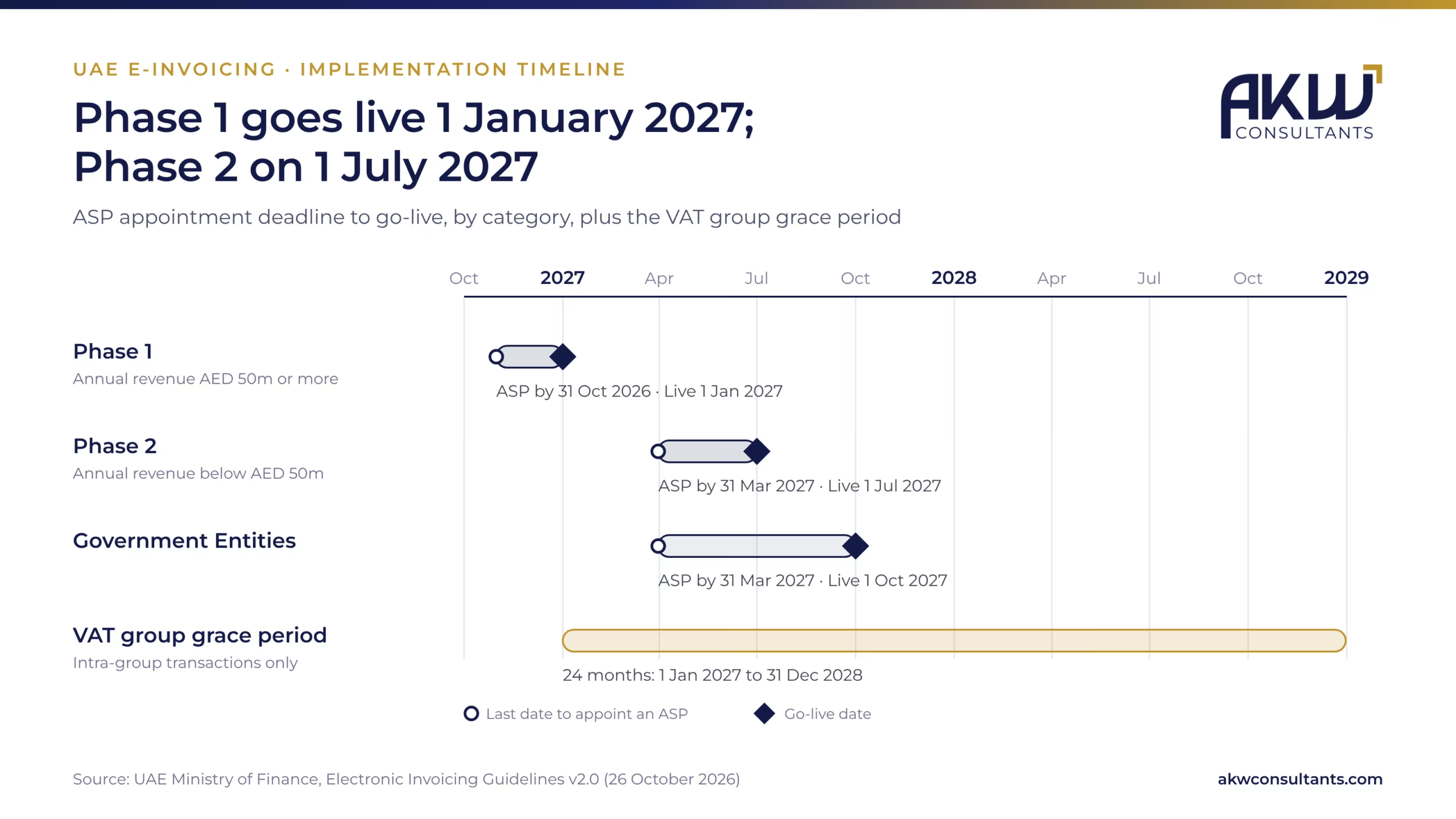
With that timeline in view, we recommend five steps:
- Map your transactions against Section 6.3: identify recharges, intra-group flows, insurer arrangements and any supplies by non-resident group entities, and record the conclusion for each.
- Confirm your phase and ASP status: Phase 1 businesses that have not yet appointed an ASP should treat this as urgent; Phase 2 businesses should begin selection now rather than in March.
- Use the VAT group grace period deliberately: plan intercompany data, pricing and ERP changes so that intra-group e-invoicing is ready well before 1 January 2029.
- Build e-invoicing into every new entity set-up: under Section 8.4, onboarding precedes the first invoice.
- Review the penalty schedule with your controls owner: assign responsibility for monitoring ASP rejections, onboarding changes and data accuracy, since continuing non-compliance accrues monthly.
Frequently Asked Questions
Does e-invoicing apply if my business is not registered for VAT?
Yes. E-invoicing applies to any Person conducting Business in the UAE regardless of VAT registration status, unless a specific exclusion applies. A Person in scope with no tax registration must register with the FTA to obtain a TIN.
Is a holding company that only receives dividends in scope?
Not if its revenue is solely passive income and it carries out no Business Transactions. Any recharge of management or other costs to related or third parties brings it into scope.
Are VAT group transactions excluded?
No. Intra-group transactions are in scope, with a 24-month grace period from 1 January 2027 that defers compliance only. Transactions with parties outside the group are not covered by the grace period.
When does a newly incorporated company need an ASP?
Before it issues its first invoice, whatever its date of establishment.
What is the maximum penalty for failing to implement e-invoicing?
Under Cabinet Decision No. 173 of 2026, AED 5,000 for the initial violation and AED 5,000 for each further month or part of a month, capped at AED 50,000 in any twelve consecutive months.
Can I be penalised twice if I am both Issuer and Recipient?
No. Only one administrative penalty applies to the same Person for the same violation.
Conclusion
Version 2.0 of the Guidelines moves the e-invoicing conversation from general awareness to entity-by-entity analysis. Holding structures, VAT groups, healthcare arrangements and new companies each now have a defined position, and Cabinet Decision No. 173 of 2026 sets a clear, capped cost for falling behind. The businesses that complete their scope assessment and ASP onboarding early will go live with fewer exceptions to manage and a defensible record of their decisions.
How AKW Consultants Can Help
AKW Consultants supports finance teams across the UAE and beyond with e-invoicing scope assessments, ASP selection and onboarding, ERP data readiness and VAT advisory. Our engagements are led by senior tax practitioners from the first conversation to go-live.
To confirm where your business stands, speak to our e-invoicing specialists.
Sources