

Three Important Reasons Why ASP Selection Matters
- Suitability of ASPs: It’s important to understand that ASP’s capabilities align with a business’s invoicing and compliance needs.
- Critical system interfaces are not regulated and must be designed correctly: The interfaces between the seller and its ASP, and between the buyer’s ASP and the buyer, are not regulated by the Ministry of Finance or the Federal Tax Authority. Commercial and technical arrangements between the business and the ASP govern these interfaces. As a result, the quality and reliability of E-Invoicing operations depend heavily on how data is mapped, how validation errors and rejections are handled, how retries and acknowledgements are managed, and how controls are embedded into daily processes. Designing and assessing these interfaces requires technical and operational expertise. A company should look at this carefully while selecting ASPs.
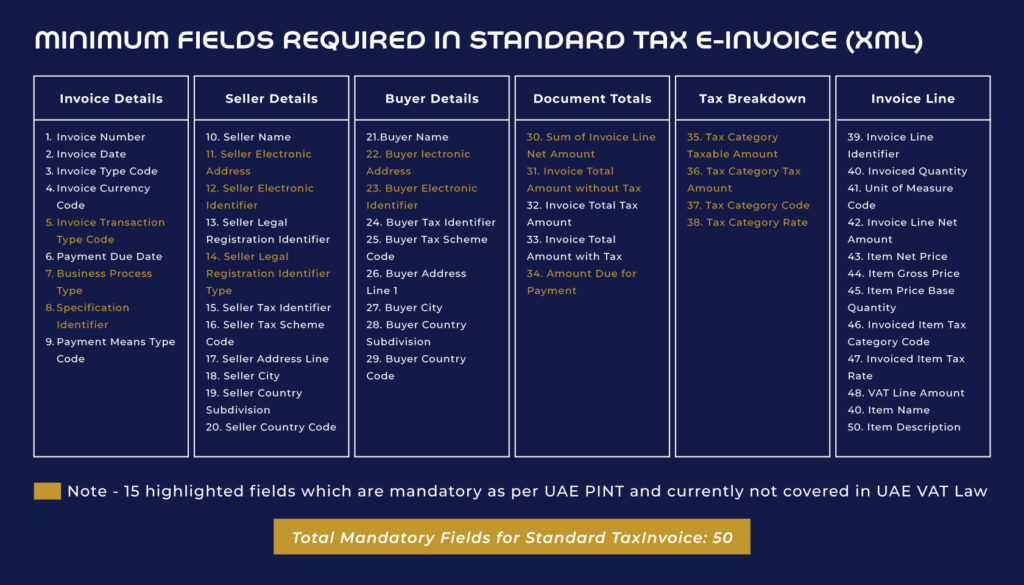
- Managing the UAE standard tax invoice XML requires strong operational and data capability: The UAE standard tax invoice XML includes 50 mandatory fields, with 15 mandatory fields currently not covered under the UAE VAT Law. If these fields are not populated correctly, invoices may fail validation, be rejected, or disrupt reporting flows. Both technical and integration support are, therefore, important.
What Businesses Should Do Now to Prepare for ASP Integration Under UAE E-Invoicing
- Start preparation within the business, not with the ASP: UAE E-Invoicing compliance cannot be achieved by appointing an ASP at the last moment. Businesses must first establish internal readiness so that processes, data, and controls can work effectively with the ASP’s systems once onboarding begins.
- Review invoice data before connecting to an ASP: Businesses should assess whether invoice data generated by their ERP or invoicing systems aligns with the UAE E-Invoicing Data Dictionary. Gaps in mandatory fields will surface during ASP validation and may lead to rejected invoices if not addressed early.
- Assess operational impact across the invoice lifecycle: How invoices are issued, corrected, cancelled, and credited must align with how the ASP validates, transmits, and reports invoice data. Manual workarounds that exist today may not function once transactions flow through the ASP.
- Plan integration with the ASP carefully: Since regulators do not prescribe how businesses connect to their ASP, companies must define how data is transmitted, how validation errors are resolved, and how acknowledgements and retries are managed in day-to-day operations.
- Establish governance for ASP interactions: Clear ownership is required for monitoring invoice status and communicating with the ASP. This is critical given the penalties that may accrue on a per-day basis.
- Train teams on working with the ASP: Finance and operational teams must understand which data they need to collect and how errors raised by the ASP are resolved.
How AKW Consultants Can Help
AKW Consultants supports businesses in implementing UAE E-Invoicing by focusing on data, systems, and operational readiness. We conduct detailed data readiness and gap assessments, mapping invoice outputs against UAE E-Invoicing data standards to identify missing or misaligned fields that could lead to validation failures. We support you with the complete Accredited Service Provider (ASP) onboarding and assist with both operational and technical integration into your systems.
Beyond implementation, we help design governance frameworks, SOPs, and internal ownership models to manage errors, data changes, and reporting obligations. Recognised with the DMCC Rising Star Award 2025, AKW combines regulatory, tax, and technology expertise to support UAE businesses in transitioning to a more efficient and transparent invoicing framework while achieving E-Invoicing compliance in line with regulatory expectations.